What Is Agentic Automation? A Complete Guide for April 2026
You're toggling between CRM, email, Slack, and three internal tools to finish one workflow, and any time the process hits an edge case, you get pulled in to fix it. That's the ceiling for traditional automation: it can handle the happy path, but the moment inputs get messy or a system changes, the script stalls. Agentic automation is built for those exact scenarios. AI agents read context across your tools, make decisions autonomously, and course-correct in real time when conditions shift. The result is fewer manual interventions and workflows that scale without breaking every time something changes.
TLDR:
- Agentic automation uses AI agents that reason, adapt, and act autonomously, unlike traditional RPA
- Gartner predicts 40% of enterprise apps will include AI agents by end of 2026, up from under 5% in 2025, while Microsoft projects there will be 1.3 billion AI agents by 2028, with Barclays estimating up to 22 billion when micro-deployments are included
- Systems handle multi-step tasks across tools, learning from outcomes to improve over time
- Start with one narrow workflow, fix data quality first, and set governance before deployment
- Composite runs locally in your existing browser with SOC-2 Type 2 compliance and zero AI subvendor data retention
What Is Agentic Automation?
Agentic automation is automation driven by AI agents that can perceive their environment, make decisions, and take action without step-by-step human instruction. Where traditional automation follows rigid, pre-programmed rules ("if X happens, do Y"), agentic systems reason through goals, adapt to changing conditions, and figure out the best path forward on their own.
Think of it this way: a macro replays the same script every time. An agentic system reads the situation, weighs its options, and acts. If something unexpected comes up, it adjusts instead of breaking.
That shift from scripted to goal-driven is what separates agentic automation from every generation of workflow tooling that came before it.
How Agentic Automation Works
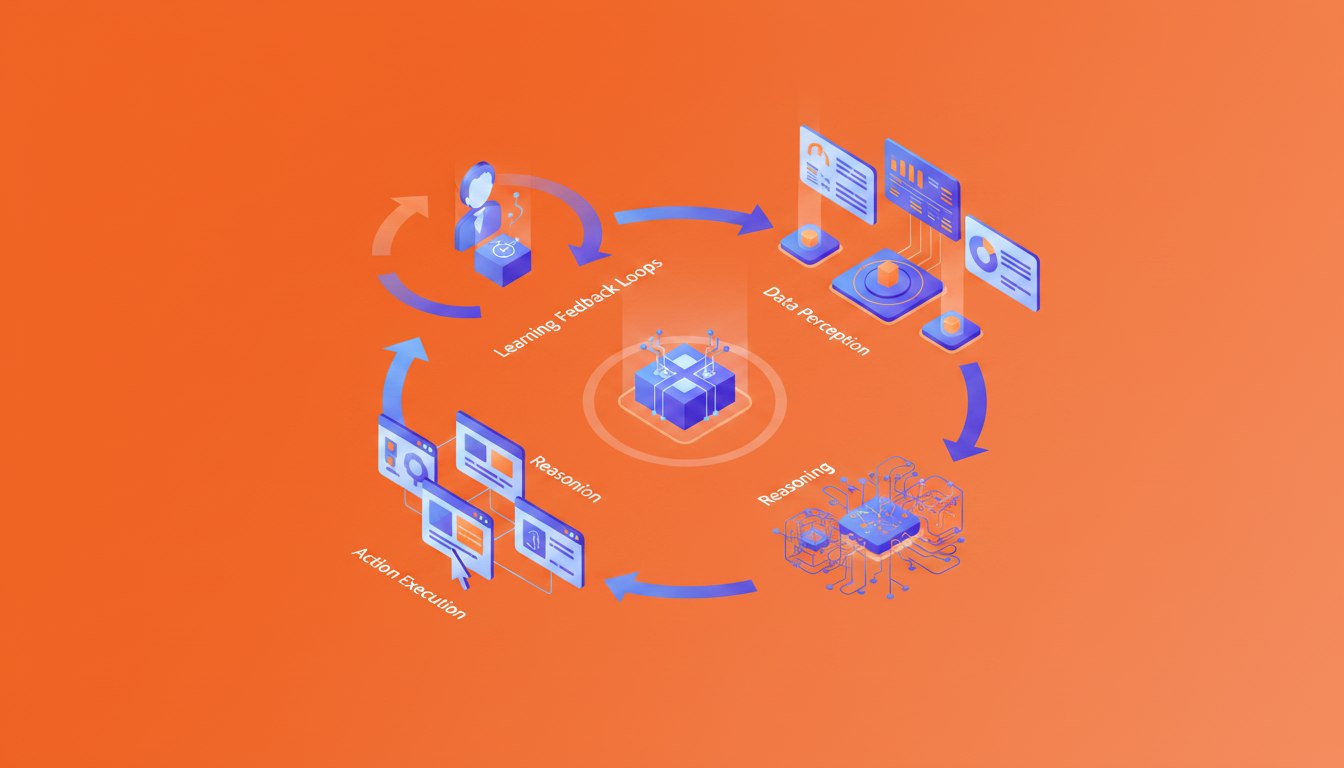
At a high level, agentic automation follows a four-stage loop:
- Perceive: The agent ingests context from its environment, whether that's screen content, database records, emails, or API responses. It builds a working picture of current conditions.
- Reason: Given a goal, it breaks the work into smaller steps and decides which to tackle first. LLMs and planning algorithms do the heavy lifting here.
- Act: The agent executes each step across whatever systems are involved, clicking through interfaces, pulling data, updating records, and sending messages.
- Learn: Results feed back into the agent's decision model. Over time, it gets faster and more accurate at choosing the right path for recurring tasks.
This loop runs continuously. The agent doesn't wait for a human to queue the next instruction. It moves from one step to the next, course-correcting when outputs don't match expectations, until the goal is met.
Agentic Automation vs Traditional Automation
The easiest way to grasp the difference is to compare the two side by side.
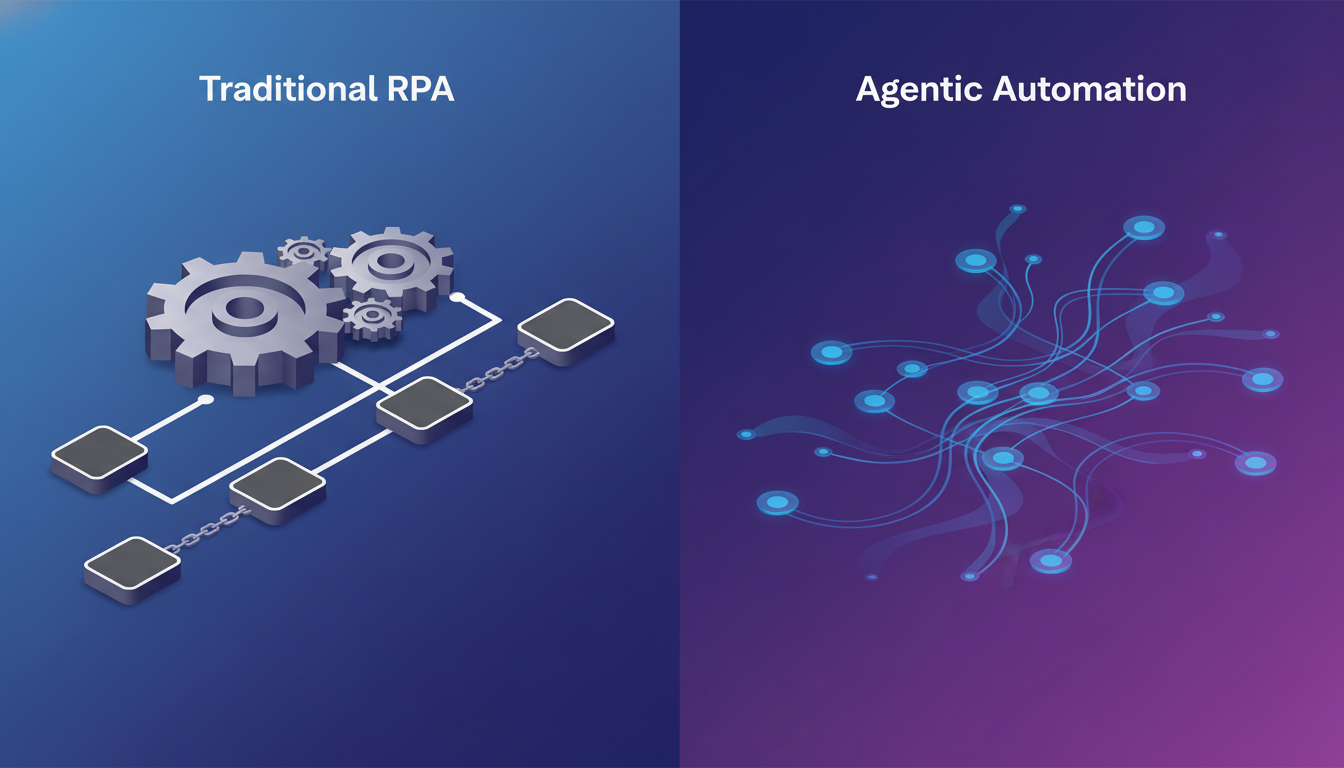
Traditional Automation (RPA) | Agentic Automation | |
|---|---|---|
Adaptability | Follows fixed scripts; breaks when UI or data changes | Adjusts to exceptions and shifting conditions in real time |
Task complexity | Structured, repetitive actions on predictable inputs | Multi-step cognitive tasks spanning multiple systems |
Intelligence | Static rule execution; no learning over time | Continuous learning from outcomes to improve future decisions |
Human involvement | Needs human intervention when exceptions arise | Escalates only when confidence is low or stakes are high |
Neither approach makes the other obsolete. RPA still excels at high-volume, perfectly structured tasks like invoice data entry. But the moment a workflow requires judgment, context switching across tools, or handling messy real-world inputs, agentic automation picks up where scripts leave off.
Benefits of Implementing Agentic Automation
The business case comes down to doing more with fewer manual touchpoints. When agents handle decision-making within workflows, teams spend less time babysitting processes and more time on work that actually requires human judgment.
Here's what that looks like in practice:
- Faster decision cycles, because agents act on context in real time instead of waiting in a queue for human review
- Scalability without linear headcount growth, since one agent can manage workloads that previously required multiple people
- Higher accuracy over time, as agents learn from outcomes and self-correct
- Graceful exception handling, even when inputs are messy or unstructured
- Cross-system orchestration without stitching together brittle point-to-point integrations
Adoption is accelerating quickly. Gartner projects that by the end of 2026, 40% of enterprise applications will include task-specific AI agents, up from less than 5% in 2025. Recent data shows that 78% of Fortune 500 companies are projected to adopt agentic systems by the end of 2026, with organizations achieving an average of 540% median ROI.
That velocity signals organizations are already seeing measurable ROI beyond pilot programs.
Key Capabilities of Agentic Automation Systems
Not every agentic automation tool offers the same feature set. When you're comparing options, these are the capabilities that separate production-ready systems from demos:
- Multi-agent orchestration allows you to coordinate specialized agents that each own a slice of a workflow, then pass results between them as tasks progress
- Real-time decision making means analyzing live data from multiple sources and acting on it without queuing for batch processing
- Cross-system integration lets agents move fluidly across CRM, ERP, email, and internal tools without requiring custom API connectors for each one
- Process intelligence provides built-in monitoring that tracks agent performance, flags bottlenecks, and suggests optimizations over time
- Governance and audit trails give you granular security controls, action logging, and role-based permissions so IT and compliance teams maintain full visibility
Which of these matters most depends entirely on your use case. A sales team needs deep cross-system integration; a compliance-focused industry will weight governance above everything else.
Agentic Automation Use Cases Across Industries
The real proof of any automation approach is where it works in practice. Here's how agentic systems are showing up across sectors:
- Finance: agents flag fraudulent transactions in real time, process insurance claims end to end, and generate financial planning recommendations based on shifting market data
- Healthcare: prior authorization workflows, medical records summarization, and patient triage routing
- Supply chain: demand forecasting that adjusts dynamically and inventory rebalancing across warehouses
- IT operations: autonomous incident resolution and continuous security monitoring
- Customer service: personalized, multi-turn issue resolution without human handoff
- HR: candidate sourcing, onboarding task orchestration, and benefits administration
Customer service stands out as the most aggressive adoption area. Gartner predicts agentic AI will autonomously resolve 80% of common service issues without human intervention by 2029.
UiPath Agentic Automation
UiPath has been one of the most visible players making the leap from traditional RPA into agentic territory. The centerpiece of that transition is Maestro, an orchestration layer designed to coordinate AI agents, classic RPA robots, and human reviewers within a single workflow. Instead of replacing its existing bot infrastructure, UiPath layers agentic capabilities on top of it.
Agents can reason and act autonomously, but governance guardrails determine when a human needs to step in. Audit logging, role-based access, and confidence thresholds keep IT and compliance teams comfortable. Industry-specific packages for healthcare and finance give teams a faster on-ramp with pre-built workflows for claims processing, patient data routing, and regulatory reporting.
If you're already invested in UiPath's ecosystem, Maestro is a natural extension. For teams starting fresh, it's worth weighing that ecosystem lock-in against more flexible, browser-native approaches.
Challenges and Risk Considerations
Agentic automation carries real risks, and glossing over them does nobody any favors. Gartner estimates that over 40% of agentic AI projects will be canceled by the end of 2027 due to escalating costs, unclear business value, or inadequate risk controls. The obstacles worth watching:
- Governance gaps: when an agent makes a bad call, who's accountable? Most orgs lack frameworks for autonomous decision liability.
- Security surface expansion: agents that move across multiple tools create more entry points for breaches.
- Orchestration complexity: coordinating multiple agents without conflicts or redundant actions is harder than it sounds.
- Change management friction: teams accustomed to manual control often resist ceding decisions to agents.
- Cost creep: LLM inference, monitoring infrastructure, and ongoing tuning add up fast, especially at scale.
Going in clear-eyed about these tradeoffs is the difference between a successful rollout and an expensive pilot that never ships.
Implementation Best Practices for Agentic Automation
Organizations seeing real results tend to follow a common playbook:
- Start narrow. Pick one high-value, well-scoped workflow instead of attempting wall-to-wall change. Prove ROI in weeks, not quarters.
- Fix your data first. Agents are only as good as the context they can access. Clean, accessible data across systems matters more than the model you choose.
- Set governance before you deploy, not after. Define escalation thresholds, decision accountability, and audit requirements upfront.
- Build for interoperability. Avoid deep lock-in to a single vendor's ecosystem. Favor tools that work across your stack so you can swap components as the space evolves.
- Monitor like it's production software. Track agent decisions, flag anomalies, and review outcomes regularly. Autonomous doesn't mean unsupervised.
Each of these sounds obvious in isolation. In practice, most failed rollouts skip at least two of them.
Browser-Based Agentic Automation with Composite
Most agentic automation tools require cloud infrastructure, API connectors, or entirely new browsers. Composite skips all of that. You invoke it with Cmd/Ctrl + Shift + Space inside Chrome, Edge, or Brave, describe what you need in plain English, and the agent executes click by click using your existing logged-in sessions. No re-authentication, no middleware.
A multi-model architecture routes each task to the right AI model. Simple actions get fast open-source models; complex visual workflows get routed to larger vision models. Proactive task detection learns your patterns over time and surfaces suggestions before you ask.
Security stays tight because execution of actions happens locally in your own browser. Our AI subvendors operate under a zero data retention policy, and we're SOC-2 Type 2 compliant. For knowledge workers buried in CRM updates, candidate research, or cross-tool data entry, that combination of speed, privacy, and zero setup overhead is where agentic automation actually becomes practical.
Final Thoughts on Agentic Automation
Agentic process automation isn't about replacing your team. It's about getting rid of the repetitive, multi-tool tasks that waste hours every week. Agents handle the grunt work, you handle the decisions that matter. If you're curious how this plays out in practice, reach out and we'll show you what Composite can automate in your workflow without any setup overhead.
FAQ
What is agentic automation?
Agentic automation is automation driven by AI agents that perceive their environment, make decisions, and take action without step-by-step human instruction. Unlike traditional automation that follows fixed scripts, agentic systems reason through goals, adapt to changing conditions, and determine the best path forward on their own. When something unexpected occurs, they adjust instead of breaking.
How is agentic ai different from traditional automation?
Traditional automation follows fixed scripts and breaks when conditions change, while agentic AI adapts to exceptions and shifting conditions in real time. Agentic systems continuously learn from outcomes to improve future decisions, whereas traditional RPA executes static rules without getting smarter over time. The key difference is that agentic automation handles judgment calls and multi-step cognitive tasks across systems, where structured, repetitive actions are the baseline.
What are the most common agentic automation use cases?
Customer service leads adoption, with Gartner predicting agentic AI will autonomously resolve 80% of common service issues by 2029. Other high-impact use cases include fraud detection and claims processing in finance, prior authorization workflows in healthcare, demand forecasting in supply chain, autonomous incident resolution in IT operations, and candidate sourcing in HR.
Can I build agentic automation without cloud infrastructure or API setup?
Yes. Browser-based agentic automation tools like Composite execute locally in your existing Chrome, Edge, or Brave browser without requiring cloud infrastructure, middleware, or API connectors. You invoke the agent with a keyboard shortcut, describe your task in plain English, and it executes using your existing logged-in sessions. No re-authentication or new software to deploy.
UiPath agentic automation vs browser-native tools?
UiPath Maestro layers agentic capabilities on top of its existing RPA infrastructure, making it a natural fit if you're already invested in their ecosystem but creating potential vendor lock-in. Browser-native tools like Composite work across your existing stack without middleware, execute locally for better security and faster deployment, and avoid the orchestration complexity of coordinating separate bot infrastructure with agentic layers.